Warning: Undefined array key "current_expo" in /var/www/clients/client3/web4/web/wp-content/themes/artaucentre/loop/vitrine.php on line 25
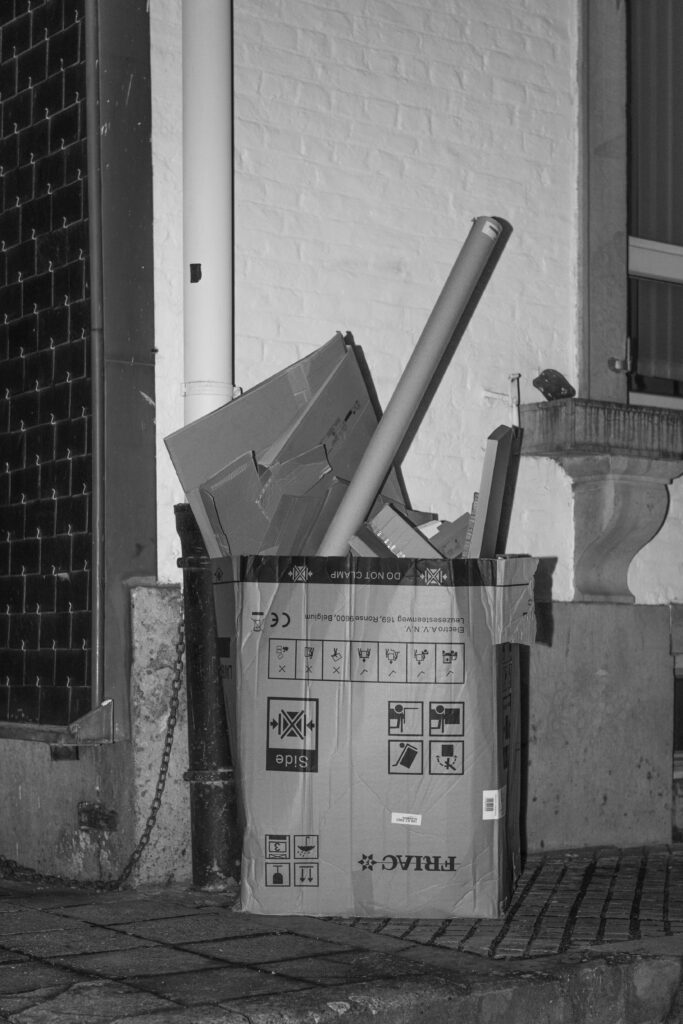
Your Parcel Is Coming
#18
Aurelien Lacroix
4325 Rue Saint-Michel
An often-overlooked aspect of everyday life lies in these ephemeral sculptures made of discarded cardboard boxes and packaging, left on sidewalks awaiting their final journey to the garbage truck. A weekly, monthly, or even bi-monthly event in more remote areas. This work explores the sculptural forms these piles of cardboard inadvertently take, transforming mundane waste into objects of contemplation. Photographed at night, the series strips the scene of any context and removes all temptation to aestheticize, leaving only these temporary monuments.
But this project goes beyond a purely graphic study. These accumulations of cardboard reflect an unrestrained consumerism. Receiving a package, once a rare event that didn’t require a dedicated collection day, is now a daily ritual for many, illustrating how radically our consumption habits have changed in just two decades.
Beyond their materiality, these boxes reveal fragments of life. Through their logos, labels, and sheer quantity, they trace an implicit economic portrait of the households that left them behind.
But they also expose something more intimate : some people stack their boxes carefully, edges cut clean, perfectly aligned and others abandon them carelessly, torn and collapsed under their own weight. Methodical or chaotic, meticulous or hurried, each leaves an unconscious mark on the pavement. Every pile becomes a sign, a trace of the home that produced it.
This silent language exists only for a few hours.Boxes left out late at night vanish by morning, swallowed by the garbage truck before the city awakens.This is the very essence of the series : to capture what few ever notice, what exists only in an in-between, a fleeting moment when the city still sleeps. To photograph them is to give presence to what disappears before it is even seen.