-
À la loupe
Werner Moron
7 Rue de l'Official
-
Cloakroom
Charlotte Delval
37 Rue Souverain Pont
-
Biospheric City
Xavier Mary
25 Rue Saint Paul
-
This Is Not a Theory
Giuseppe Arnone
40 Rue Hors-Château
-
Barbaro after the hunt
Andréa Le Guellec
56 Rue Saint-Gilles
-
Nos lieux de bonheur
Benjamin Hollebeke
141 Féronstrée
-
Between Two
Adrien Milon
31b Rue de la Cathédrale
-
Your Parcel Is Coming
Aurelien Lacroix
5 Rue Saint-Michel
-
Marcher, cueillir, jardiner, teindre
Benjamin Huynh
32 Rue de la Madeleine
-
À nos jours heureux
DIAAAne (Diane Stordiau)
28 - 30 Boulevard d'Avroy
-
One Loft Race — Pigeon Paradise
Lucas Castel
20 Rue de la Sirène
-
Les envahisseurs
Dimitri Autin
85 Rue de la Cathédrale
-
Vous êtes toustes flou·e·s
Marcelle Germaine
107 - 109 Rue de la Cathédrale
-
Le jeu d’un destin
Mikaïl Koçak
52 En Neuvice
-
Rue Monrose, 62 : La chambre L’enfant Le train
Paul Gérard
180 Rue Saint-Gilles
-
Peek
Raphaël Meng WU
75 Rue Hors-Château
-
Un buisson de clés (Sleutelbos)
Amber Roucourt
16 Rue du Palais
-
Brownfields
Cesare Botti
108 Féronstrée
-
Never Finished
Dirk Bours
84 Féronstrée
-
Empty Reflections
Jason Slabbynck
21 Pont d'Île
-
On « Sexy Magico »
Louis Gahide
7 Rue Lambert Lombard
-
Opalima Kupina: Liège episode A Stop Pavilion: On the Soft Underbelly of Europe.
Nikolay Karabinovych
1 Féronstrée
-
Untitled
Reza Kianpour
14 Rue de la Populaire
-
Angle Mort
VIVONS CACHÉ·ES
31a Rue de la Cathédrale
-
Haya al salat, haya ala falah*
Sarah Van Melick
4 Rue de la Cathédrale
Warning: Undefined array key "current_expo" in /var/www/clients/client3/web4/web/wp-content/themes/artaucentre/loop/vitrine.php on line 25
Never Finished
#18
Dirk Bours
Curator : MC Krell, in collaboration with Bours-de Bruijn family
42184 Féronstrée
Dirk Bours’ paintings originate from his many forays through the urban landscape. Inspired by cities such as Bucharest, Vienna, Istanbul, London, Berlin, Madrid, Helsinki, and New York, he explored the structure of the contemporary city itself by capturing its form and composition, rhythm and materiality. Bours extracted fragments from photographs of street scenes, buildings, and industrial zones to transform them into paintings that exist between abstraction and figuration. At first glance, his work appears as an abstract arrangement of colors and geometry. On closer inspection, embedded elements emerge, for instance the hoods above traffic lights, revealing a sense of spatial depth.
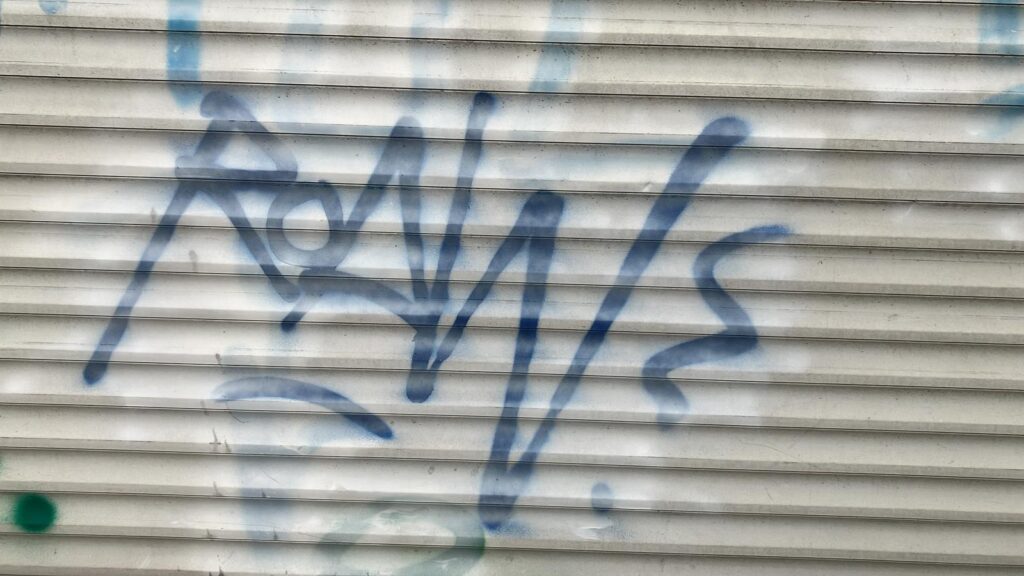
Bours’ visual language evolved from experiences as a graffiti artist, through photography and graphic design, still visible in traces of sharp lines, bold signs, and architectural structures. His painting process mirrored the city itself as an organic cycle of construction and deconstruction. He repeatedly built up, broke down, and reworked layers of paint, with each layer guiding the next. Like a city, his paintings were never fully planned nor definitively finished, constantly changing, shaped by accumulation and loss.
Rather than depicting the specific places he visited, his works resist fixed reference points, proposing instead a visual abstraction of the ongoing transformation of urban life. His paintings remain open, inviting the viewer to trace his decisions and revisions that structure their surfaces, preserving what a city erases.