-
À la loupe
Werner Moron
7 Rue de l'Official
-
Cloakroom
Charlotte Delval
37 Rue Souverain Pont
-
Biospheric City
Xavier Mary
25 Rue Saint Paul
-
This Is Not a Theory
Giuseppe Arnone
40 Rue Hors-Château
-
Barbaro after the hunt
Andréa Le Guellec
56 Rue Saint-Gilles
-
Nos lieux de bonheur
Benjamin Hollebeke
141 Féronstrée
-
Between Two
Adrien Milon
31b Rue de la Cathédrale
-
Your Parcel Is Coming
Aurelien Lacroix
5 Rue Saint-Michel
-
Marcher, cueillir, jardiner, teindre
Benjamin Huynh
32 Rue de la Madeleine
-
À nos jours heureux
DIAAAne (Diane Stordiau)
28 - 30 Boulevard d'Avroy
-
One Loft Race — Pigeon Paradise
Lucas Castel
20 Rue de la Sirène
-
Les envahisseurs
Dimitri Autin
85 Rue de la Cathédrale
-
Vous êtes toustes flou·e·s
Marcelle Germaine
107 - 109 Rue de la Cathédrale
-
Le jeu d’un destin
Mikaïl Koçak
52 En Neuvice
-
Rue Monrose, 62 : La chambre L’enfant Le train
Paul Gérard
180 Rue Saint-Gilles
-
Peek
Raphaël Meng WU
75 Rue Hors-Château
-
Un buisson de clés (Sleutelbos)
Amber Roucourt
16 Rue du Palais
-
Brownfields
Cesare Botti
108 Féronstrée
-
Never Finished
Dirk Bours
84 Féronstrée
-
Empty Reflections
Jason Slabbynck
21 Pont d'Île
-
On « Sexy Magico »
Louis Gahide
7 Rue Lambert Lombard
-
Opalima Kupina: Liège episode A Stop Pavilion: On the Soft Underbelly of Europe.
Nikolay Karabinovych
1 Féronstrée
-
Untitled
Reza Kianpour
14 Rue de la Populaire
-
Angle Mort
VIVONS CACHÉ·ES
31a Rue de la Cathédrale
-
Haya al salat, haya ala falah*
Sarah Van Melick
4 Rue de la Cathédrale
Warning: Undefined array key "current_expo" in /var/www/clients/client3/web4/web/wp-content/themes/artaucentre/loop/vitrine.php on line 25
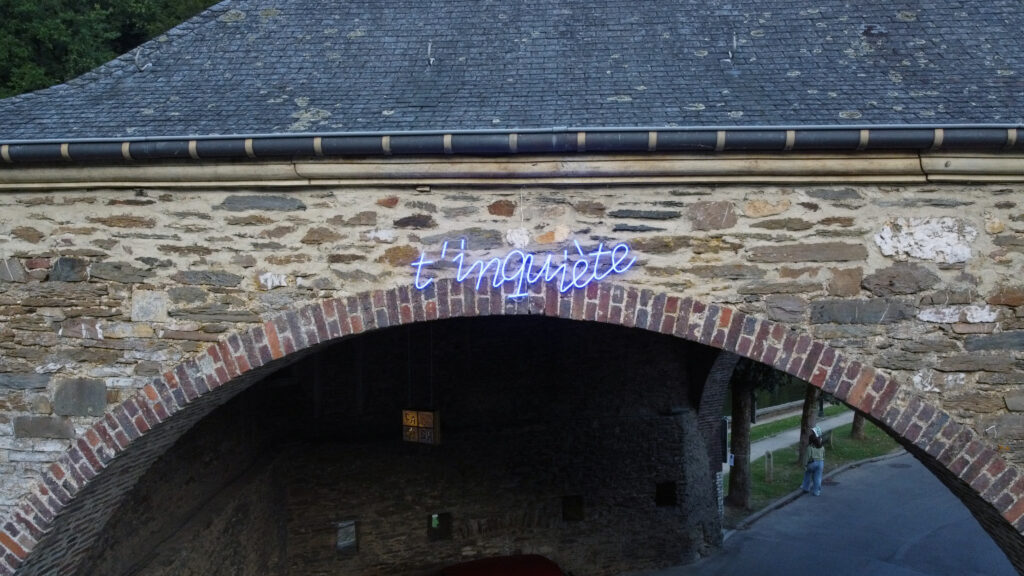
Le jeu d’un destin
#18
Mikaïl Koçak
Curator : Thibaut Wauthion
43152 En Neuvice
Urban economics at street level lies at the heart of Mikaïl Koçak’s practice. Scattered across several shop windows in the city center, his intervention builds on a shared observation: the multiplication of empty shops, soaring rents and increasing tax pressure.
His installation explores the mechanisms that transform the city center into a space of transit rather than a place to live. Through this fragmented occupation of windows, the artist reveals often abstract logics: loads of intermediaries, taxes and commissions (small or large) that condition the circulation of goods, bodies and services.
These issues are addressed through the distortion of language and play that usually lie at the core of Mikaïl Koçak’s artistic work. He appropriates both familiar expressions and popular forms of entertainment to develop a narrative that fluctuates between playful humor and a critique of a dysfunctional situation.
For beneath humor emerges a political reading: that of a system in which everyone claims their cut, from the city to the property owner, from the owner to the shopkeeper, and ultimately to the end consumer. Mikaïl Koçak more broadly questions structures of intermediation that have become indispensable, but also organize, and sometimes lock down, the access to resources. Small and large commissions punctuate our everyday life, embedding themselves in all sectors and fields.
Mikaïl Koçak implicitly transforms empty shop windows into speculative platforms. Midway between laughter and unease, his installation invites us to look differently at the economic mechanisms of a city conceived more for transaction than for proper use.