Warning: Undefined array key "current_expo" in /var/www/clients/client3/web4/web/wp-content/themes/artaucentre/loop/vitrine.php on line 25
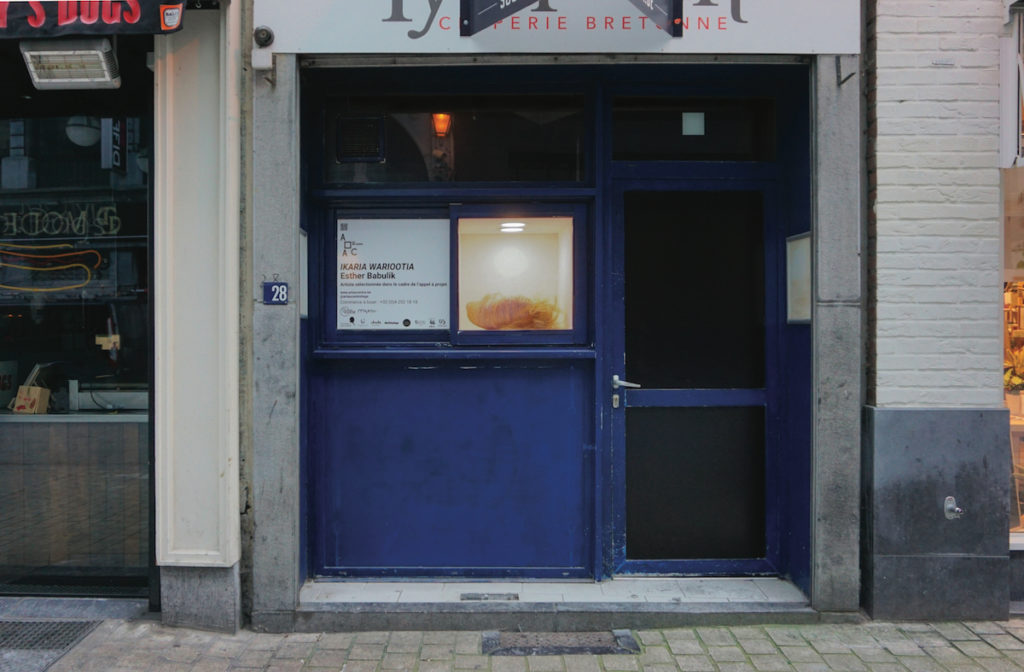
IKARIA WARIOOTIA
#5
Esther Babulik
Open call
9528 Rue Pont d'Avroy
« The rotting carcass is my starting point. It refers to a term of decomposing and thus transforming body, soft body becoming hard, animal or human body, body source of life but dead. It is a matter of describing a movement towards a metamorphosis. The body is not body anymore and became a faceless pile, a thing that we can’t qualify, the flesh gets mixed up with the hair. Thanks to the wax, it seems to breathe. Its unrecognizable shape contrasts with its living aspect, as if to reverse the process, sometimes birth, sometimes death, the reading can be done both ways. The birth, namely the creation, the generation, would respond complementarily to the decomposition. These two movements would respond to each other symmetrically.
The body is a living matter that is going to be recycled, redistributed. So, if we consider each entity with its environment, considering it as being part of a whole, we could thus imagine that any life is made of a single matter that changes its appearance freely like a wax that we would melt endlessly.
I like the idea that the body is not cultural nor natural, the idea that it becomes both and that from now on our relationship with nature comes down to forced and repressed drives. I try to wonder about these states of limit, these zones where the boundaries seem to disappear. Ambivalences converge and a transformation will originate from that.
This sculpture is inspired by the Ikaria wariootia, a vermiform animal that seems to be the oldest example of bilateria, the body shape shared by the vast majority of animals since then. It is perhaps the ancestor of the animal kingdom, including humans. »
