Warning: Undefined array key "current_expo" in /var/www/clients/client3/web4/web/wp-content/themes/artaucentre/loop/vitrine.php on line 25
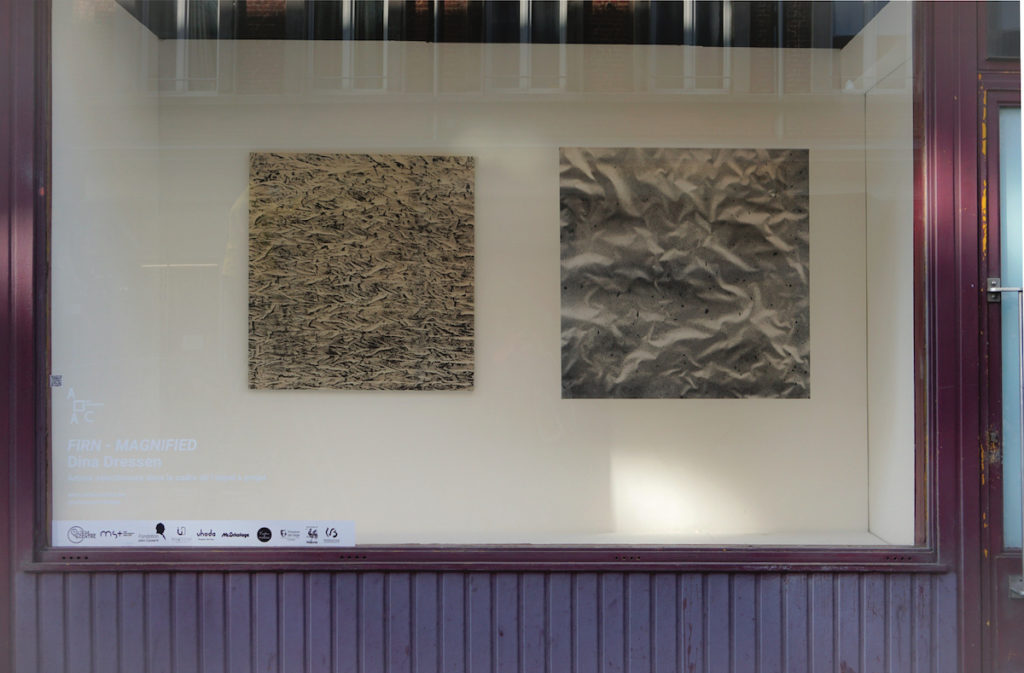
Firn – Magnified
#5
Dina Dressen
Open call
1024 Rue du Rêwe
Dina Dressen is a visual artist based in Maastricht, working between drawing, print, and installation. Using simple means : Indian ink, water, paper, and canvas, Dressen creates her complex visual universe. She tends to deploy techniques which mimic chemical and geological processes, such as absorption, sedimentation, and surface runoff. They resound in the titles and account for the natural textures of her works : the coarseness of the stone, the grittiness of sand, the smoothness of water.
In her early practice, Dressen was exploring analogue photography, and its influence can still be seen today, in her fascination with fluidity as well as in the black and white palette, strong contrasts, and grainy quality of her works. Akin to a photographer, Dressen allows her work to emerge out of the darkness, but instead of submerging the film in the photographic developer, she immerses her materials in the mixture of ink and water.
Dressen’s studio is a space for unbounded experimentation with different variables : material, time, space, and chance. She lets her work be led by these variables and develop itself organically through repetition and layering but also deviation. To her, making is first and foremost an experiment, without an end in sight. In this experiment, intention and serendipity play an equal part, accounting for the uniqueness of each work and, at the same time, a sense of unity.
