-
À la loupe
Werner Moron
7 Rue de l'Official
-
Cloakroom
Charlotte Delval
37 Rue Souverain Pont
-
Biospheric City
Xavier Mary
25 Rue Saint Paul
-
This Is Not a Theory
Giuseppe Arnone
40 Rue Hors-Château
-
Barbaro after the hunt
Andréa Le Guellec
56 Rue Saint-Gilles
-
Nos lieux de bonheur
Benjamin Hollebeke
141 Féronstrée
-
Between Two
Adrien Milon
31b Rue de la Cathédrale
-
Your Parcel Is Coming
Aurelien Lacroix
5 Rue Saint-Michel
-
Marcher, cueillir, jardiner, teindre
Benjamin Huynh
32 Rue de la Madeleine
-
À nos jours heureux
DIAAAne (Diane Stordiau)
28 - 30 Boulevard d'Avroy
-
One Loft Race — Pigeon Paradise
Lucas Castel
20 Rue de la Sirène
-
Les envahisseurs
Dimitri Autin
85 Rue de la Cathédrale
-
Vous êtes toustes flou·e·s
Marcelle Germaine
107 - 109 Rue de la Cathédrale
-
Le jeu d’un destin
Mikaïl Koçak
52 En Neuvice
-
Rue Monrose, 62 : La chambre L’enfant Le train
Paul Gérard
180 Rue Saint-Gilles
-
Peek
Raphaël Meng WU
75 Rue Hors-Château
-
Un buisson de clés (Sleutelbos)
Amber Roucourt
16 Rue du Palais
-
Brownfields
Cesare Botti
108 Féronstrée
-
Never Finished
Dirk Bours
84 Féronstrée
-
Empty Reflections
Jason Slabbynck
21 Pont d'Île
-
On « Sexy Magico »
Louis Gahide
7 Rue Lambert Lombard
-
Opalima Kupina: Liège episode A Stop Pavilion: On the Soft Underbelly of Europe.
Nikolay Karabinovych
1 Féronstrée
-
Untitled
Reza Kianpour
14 Rue de la Populaire
-
Angle Mort
VIVONS CACHÉ·ES
31a Rue de la Cathédrale
-
Haya al salat, haya ala falah*
Sarah Van Melick
4 Rue de la Cathédrale
Warning: Undefined array key "current_expo" in /var/www/clients/client3/web4/web/wp-content/themes/artaucentre/loop/vitrine.php on line 25
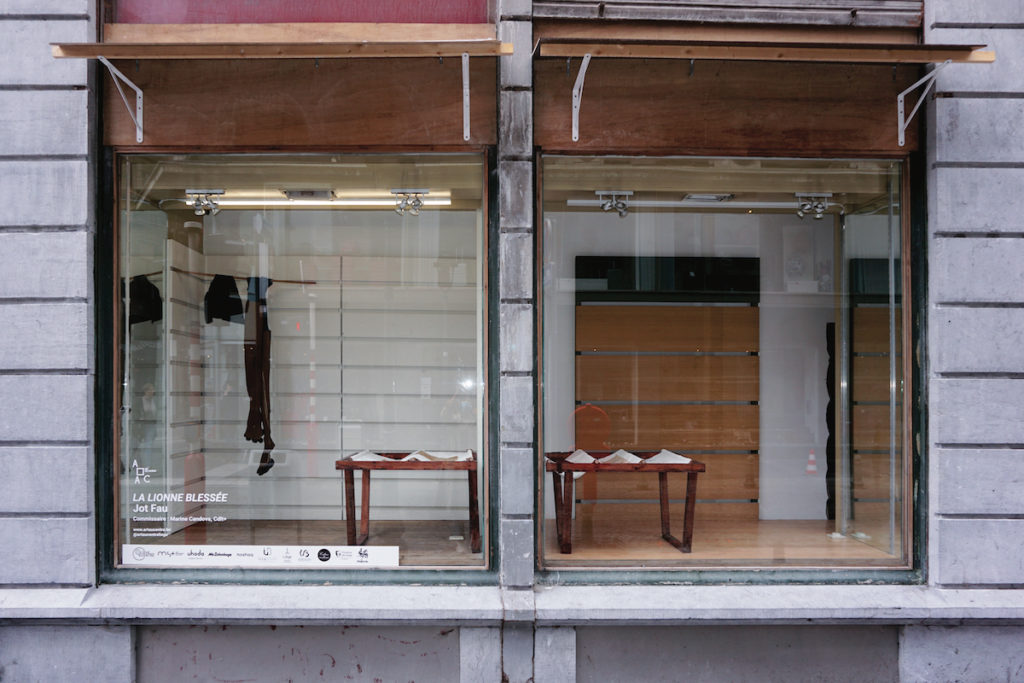
la lionne blessée
#3
Jot Fau
Curator : Marine Candova
5063 Rue de la Cathédrale
The installation is made up of a rudimentary wooden structure that resembles a camp bed. Draped over the structure, a cotton veil is divided into a series of compartments. These are like a stall on which the figure of a wounded lioness is put forward. On the fabric, the fawn is depicted multiple times and in a multitude of ways. These designs take shape through embroidery. The construction and deconstruction of the original image* creates a kind of pattern, evolving from compartment to compartment, hence digging through these sequences the representation of the lioness body, (de)formed by pain.
The bas-relief dating from the ancient Assyrian period that inspired this work features the animal, injured during a hunting scene. Between strength and fragility, pain and resistance. Half of its body is erect, sturdy and tough. The other half dragged along the floor, badly injured and almost devastated. This heartbreaking hunting scene reveals a solitary body that moves intensely between life and death. La Lionne Blessée – The Blessed Lioness. These two sister phrases are embroidered on the cotton veil, among the different representations of the feline. The erroneous translation** makes it possible to shift the gaze by placing the lioness in a broader context. By turning the tide and surrounding it with hope and divine impulse, leaving more room for the strong and resilient half of its body, and hence for life itself. In the “Fishing and Hunting” section of the old Humblet pet store, you could buy cots. The object or image of the bed recurs repeatedly in Jot Fau’s work. The bed evokes a sort of body repairing that one can imagine exhausted or injured. The cot interests her all the more because she imagines it without an owner. Like a free and primary form whose mission would be to accommodate a large number of bodies in need.
* The wounded lioness is part of the Assyrian frieze of the hunt of Ashurbanipal of Nineveh, on display in the British Museum in London.
** The Blessed Lioness translates to La Lionne bénite
* La lionne blessée fait partie de la frise Assyrienne de la chasse d’Assurbanipal de Ninive, visible au British Museum à Londres.
** The Blessed Lioness se traduit par La Lionne bénite
