-
À la loupe
Werner Moron
7 Rue de l'Official
-
Cloakroom
Charlotte Delval
37 Rue Souverain Pont
-
Biospheric City
Xavier Mary
25 Rue Saint Paul
-
This Is Not a Theory
Giuseppe Arnone
40 Rue Hors-Château
-
Barbaro after the hunt
Andréa Le Guellec
56 Rue Saint-Gilles
-
Nos lieux de bonheur
Benjamin Hollebeke
141 Féronstrée
-
Between Two
Adrien Milon
31b Rue de la Cathédrale
-
Your Parcel Is Coming
Aurelien Lacroix
5 Rue Saint-Michel
-
Marcher, cueillir, jardiner, teindre
Benjamin Huynh
32 Rue de la Madeleine
-
À nos jours heureux
DIAAAne (Diane Stordiau)
28 - 30 Boulevard d'Avroy
-
One Loft Race — Pigeon Paradise
Lucas Castel
20 Rue de la Sirène
-
Les envahisseurs
Dimitri Autin
85 Rue de la Cathédrale
-
Vous êtes toustes flou·e·s
Marcelle Germaine
107 - 109 Rue de la Cathédrale
-
Le jeu d’un destin
Mikaïl Koçak
52 En Neuvice
-
Rue Monrose, 62 : La chambre L’enfant Le train
Paul Gérard
180 Rue Saint-Gilles
-
Peek
Raphaël Meng WU
75 Rue Hors-Château
-
Un buisson de clés (Sleutelbos)
Amber Roucourt
16 Rue du Palais
-
Brownfields
Cesare Botti
108 Féronstrée
-
Never Finished
Dirk Bours
84 Féronstrée
-
Empty Reflections
Jason Slabbynck
21 Pont d'Île
-
On « Sexy Magico »
Louis Gahide
7 Rue Lambert Lombard
-
Opalima Kupina: Liège episode A Stop Pavilion: On the Soft Underbelly of Europe.
Nikolay Karabinovych
1 Féronstrée
-
Untitled
Reza Kianpour
14 Rue de la Populaire
-
Angle Mort
VIVONS CACHÉ·ES
31a Rue de la Cathédrale
-
Haya al salat, haya ala falah*
Sarah Van Melick
4 Rue de la Cathédrale
Warning: Undefined array key "current_expo" in /var/www/clients/client3/web4/web/wp-content/themes/artaucentre/loop/vitrine.php on line 25
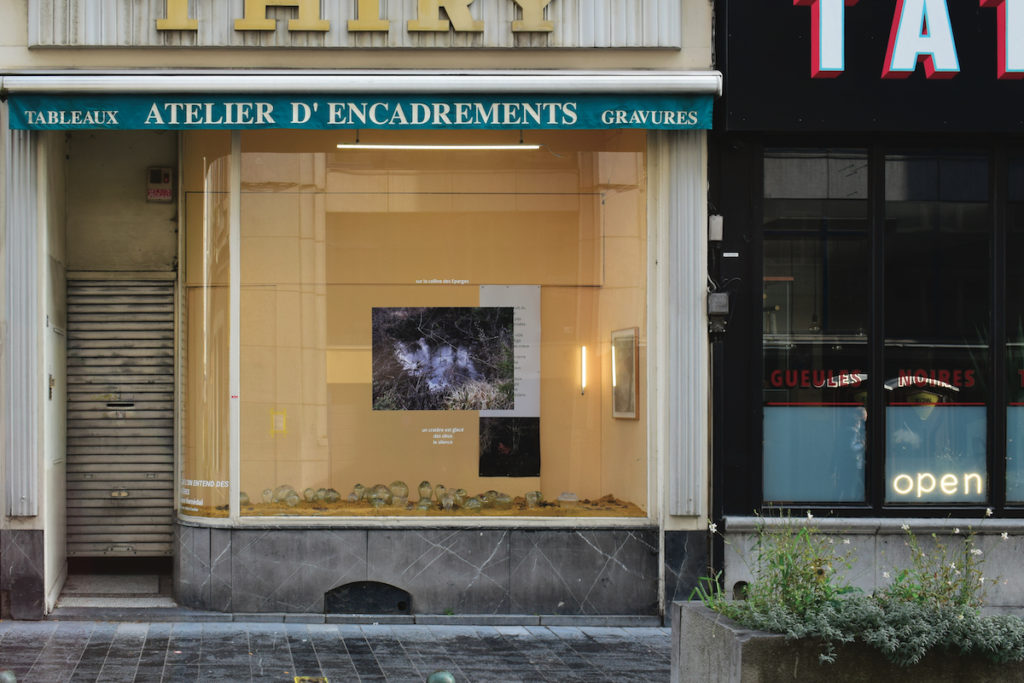
CE QUE L’ON ENTEND DES CRATÈRES
#7
Maxime Vernédal
Curator : Arthur Cordier
17129 Rue de l'Université
Maxime Vernédal is a French artist based in Brussels. He holds a Master’s Degree in Urban Space (ENSAV La Cambre). Maxime Vernédal’s practice is multidisciplinary.
The selection of the material is the start of his approach : it is the first interpretation level of his expression. The clay, glass, sound material, written material, pictures, memories are objects that he presents as a constellation.
As he was adopted, the notions of places, origins and identity are the starting point of his thoughts. This latitude of thoughts is always in motion between construction and deconstruction. In Ce que l’on entend des cratères, the approach of using the clay of Verdun battlefields goes into this perpetual movement of construction and deconstruction. It is the basis of this desire of legitimation, of belonging to this land, the land of his childhood, one of the constructions of his identity. This land has a dual use and a dual language : it is also tinged with a more global story. This tension between his story and our story is deliberate. In his approach, glass is a flash of energy and also a craft industry anchored in French Great East region.
The clash of these two materials – clay and glass – is described in breath, in high intensity of heat, and in a limited time. The printing, made with acetone and then goffered, is a reflection on destroying to rebuild. The artwork talks about palimpsest, memory and occasionally erroneous perceptions of past elements. It is a short story about an interpretation mistake by the artist. It yet led to this whole approach around clay and its asperities (scars, craters).

