-
À la loupe
Werner Moron
7 Rue de l'Official
-
Cloakroom
Charlotte Delval
37 Rue Souverain Pont
-
Biospheric City
Xavier Mary
25 Rue Saint Paul
-
This Is Not a Theory
Giuseppe Arnone
40 Rue Hors-Château
-
Barbaro after the hunt
Andréa Le Guellec
56 Rue Saint-Gilles
-
Nos lieux de bonheur
Benjamin Hollebeke
141 Féronstrée
-
Between Two
Adrien Milon
31b Rue de la Cathédrale
-
Your Parcel Is Coming
Aurelien Lacroix
5 Rue Saint-Michel
-
Marcher, cueillir, jardiner, teindre
Benjamin Huynh
32 Rue de la Madeleine
-
À nos jours heureux
DIAAAne (Diane Stordiau)
28 - 30 Boulevard d'Avroy
-
One Loft Race — Pigeon Paradise
Lucas Castel
20 Rue de la Sirène
-
Les envahisseurs
Dimitri Autin
85 Rue de la Cathédrale
-
Vous êtes toustes flou·e·s
Marcelle Germaine
107 - 109 Rue de la Cathédrale
-
Le jeu d’un destin
Mikaïl Koçak
52 En Neuvice
-
Rue Monrose, 62 : La chambre L’enfant Le train
Paul Gérard
180 Rue Saint-Gilles
-
Peek
Raphaël Meng WU
75 Rue Hors-Château
-
Un buisson de clés (Sleutelbos)
Amber Roucourt
16 Rue du Palais
-
Brownfields
Cesare Botti
108 Féronstrée
-
Never Finished
Dirk Bours
84 Féronstrée
-
Empty Reflections
Jason Slabbynck
21 Pont d'Île
-
On « Sexy Magico »
Louis Gahide
7 Rue Lambert Lombard
-
Opalima Kupina: Liège episode A Stop Pavilion: On the Soft Underbelly of Europe.
Nikolay Karabinovych
1 Féronstrée
-
Untitled
Reza Kianpour
14 Rue de la Populaire
-
Angle Mort
VIVONS CACHÉ·ES
31a Rue de la Cathédrale
-
Haya al salat, haya ala falah*
Sarah Van Melick
4 Rue de la Cathédrale
Warning: Undefined array key "current_expo" in /var/www/clients/client3/web4/web/wp-content/themes/artaucentre/loop/vitrine.php on line 25
NAPOLÉON
#6
Tim Volckaert
Curator: Sandrine Bouillon
14620 Rue de l'Université
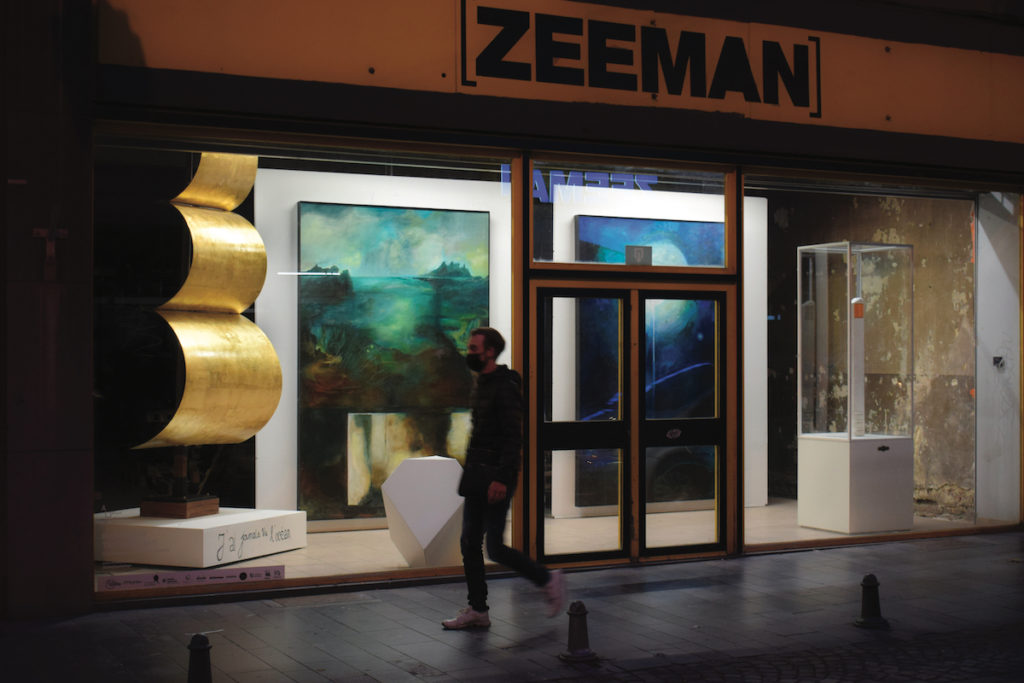
The connection between humans and the landscape is a central theme that binds Tim Volckaert’s actions, drawings, sculptures, installations, photographs and paintings. How do humans identify with their environment ? In a recent series of paintings, the artist analyzed typical portraits of conceited bourgeois painted in front of a scenery whose main function is to highlight their opulence. In the past already, he had deconstructed and corrected this duality in strange paintings showing a harmonious fusion between foreground and background, humans and landscape. In his last artworks, Tim Volckaert further reflects on the way power structures – humans facing their environment, but also human beings among themselves – are visible in history.
The creation of similar portraits as of the Renaissance goes hand in hand with a growing desire of expansion and world conquest by European powers. In these paintings, the artists added numerous symbolic references to the masculinity of the figures. Let’s think for example of the famous Bonaparte crossing the Great Saint Bernard by Jacques-Louis David (1801). Napoleon mounts a reared-up horse, his finger pointing up, sign that he can also conquer the sky. Moreover, in such majestic portraits, the male genitals – although covered – are usually dramatically represented. In his Napoleon, Tim Volckaert focuses on one of these bulging and figure-hugging trousers to draw our attention to a caustic truth : the history (of art), and by extension the world, significantly follows the model of the heterosexual man.

