-
À la loupe
Werner Moron
7 Rue de l'Official
-
Cloakroom
Charlotte Delval
37 Rue Souverain Pont
-
Biospheric City
Xavier Mary
25 Rue Saint Paul
-
This Is Not a Theory
Giuseppe Arnone
40 Rue Hors-Château
-
Barbaro after the hunt
Andréa Le Guellec
56 Rue Saint-Gilles
-
Nos lieux de bonheur
Benjamin Hollebeke
141 Féronstrée
-
Between Two
Adrien Milon
31b Rue de la Cathédrale
-
Your Parcel Is Coming
Aurelien Lacroix
5 Rue Saint-Michel
-
Marcher, cueillir, jardiner, teindre
Benjamin Huynh
32 Rue de la Madeleine
-
À nos jours heureux
DIAAAne (Diane Stordiau)
28 - 30 Boulevard d'Avroy
-
One Loft Race — Pigeon Paradise
Lucas Castel
20 Rue de la Sirène
-
Les envahisseurs
Dimitri Autin
85 Rue de la Cathédrale
-
Vous êtes toustes flou·e·s
Marcelle Germaine
107 - 109 Rue de la Cathédrale
-
Le jeu d’un destin
Mikaïl Koçak
52 En Neuvice
-
Rue Monrose, 62 : La chambre L’enfant Le train
Paul Gérard
180 Rue Saint-Gilles
-
Peek
Raphaël Meng WU
75 Rue Hors-Château
-
Un buisson de clés (Sleutelbos)
Amber Roucourt
16 Rue du Palais
-
Brownfields
Cesare Botti
108 Féronstrée
-
Never Finished
Dirk Bours
84 Féronstrée
-
Empty Reflections
Jason Slabbynck
21 Pont d'Île
-
On « Sexy Magico »
Louis Gahide
7 Rue Lambert Lombard
-
Opalima Kupina: Liège episode A Stop Pavilion: On the Soft Underbelly of Europe.
Nikolay Karabinovych
1 Féronstrée
-
Untitled
Reza Kianpour
14 Rue de la Populaire
-
Angle Mort
VIVONS CACHÉ·ES
31a Rue de la Cathédrale
-
Haya al salat, haya ala falah*
Sarah Van Melick
4 Rue de la Cathédrale
Warning: Undefined array key "current_expo" in /var/www/clients/client3/web4/web/wp-content/themes/artaucentre/loop/vitrine.php on line 25
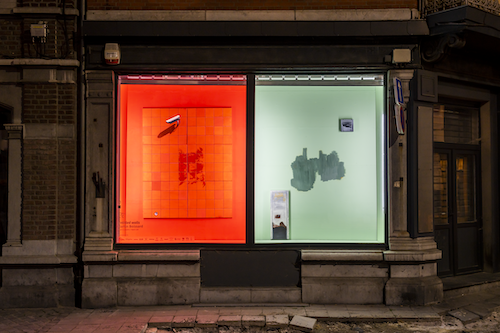
Untitled walls
#10
Martin Boissard
Artist selected as part of the open call
2272 Rue Matrognard
A fan of skateboarding culture, Martin Boissard has an alternative vision of the environment and street furniture, that are considered as a potential playground. The wandering, the search for new “spots” tirelessly pushes him to discover new spaces, often off the beaten track and this is where his artistic work was born.
The first stage of his pictorial practice consists in the exploration of urban space. These peregrinations are sometimes synonymous with wandering or discoveries and lead him to take many shots. Vandalized or decrepit walls, palisades, lacerated posters or any other flat surface that will echo the flatness of the painter’s canvas. This obsessive work leads him to a real photographic inventory of what he calls the “pictorial accidents” that line the streets he has paced up and down.
These different subjects enable him to approach painting in its diversity by relying on artistic and pictorial currents as diverse as they are varied. Thus, a wall with graffiti erased by a layer of paint that is different from its original color, hence creating a nebulous abstract form, can be seen as a reference to Rothko’s work. A tag erased with a high-pressure washer will leave visible traces on the wall and will be condemned to wander like a ghost of what it used to be, like an Erased de Kooning Drawing by Rauschenberg.
Although figurative, his pictorial work is nonetheless steeped in abstraction, whether expressionist or geometric. He plays on the opposition between these diametrically opposed pictorial currents. This dichotomy is a real sounding board in his work.
His approach also claims and questions the two-dimensionality of the canvas. By accentuating frontality, by deliberately reducing perspective to a minimum, his work does not seek to give the illusion of a three-dimensional space, but rather to play with flatness and its opposite, depth.